Monday, June 4, 2018

How to Cure the "Hangry" - and it's not with extra snacks

Most of us have heard the word "hangry," which describes the irritability we can feel after not eating for a certain amount of time. In my clinical practice, the magic amount of time that patients say it takes is typically 3 hours. I need to eat every three hours, or I get shaky and really grumpy!

And it's not just what I'm hearing from others, but also what I've experienced first hand. We have a word for it in our family too... when someone starts acting irrational and grumpy because they haven't eaten in a couple hours...

But when you think about it, a few hours is practically nothing. Three hours, and our bodies are begging for food again? Seems a little illogical looking at how many calories we're consuming each day. So what's really happening and how can we fix it?

"Hangry" is a sign of blood sugar dysregulation, and it happens more often in those with higher carbohydrate diets. In a nutshell, consuming regular and relatively large amounts of refined carbohydrates and sugars as a main fuel source results in those sugars ending up in the bloodstream. This is what increases blood sugar levels and it requires insulin to pop up to let the sugar into the body's cells; as well, the liver will help store the sugar you're not using as glycogen.

Spikes and drops in blood sugar levels can definitely affect our mood and energy. It can also lead to further complications long-term like insulin resistance - where we continuously bombard our bodies with so much refined carbs/sugars that insulin can't meet the demand.

Apart from hypoglycaemic symptoms, insulin resistance is associated with obesity, PCOS, type 2 diabetes, and metabolic syndrome. As well, blood sugar dysregulation can lead to non-alcoholic fatty liver disease.

The good news is that blood sugar regulation can be corrected with dietary and lifestyle changes (the rate of which will depend on the individual). Here are some tips to get started:


  • Avoid eating at night, or eat only within a 12-hour window, max. Fasting for at least 12 hours will help train the body to not just use sugars/carbohydrates as a fuel source as you're not feeding yourself throughout the night. Therefore, the body tends to use up glycogen stores from the liver, and eventually fat if it needs it.
  • Reduce refined sugars and carbohydrates in the diet. This isn't to say that all grains are terrible for you, but you don't need them as much as our old food pyramids have historically told us. 
    • Avoid those daily breakfast sandwiches, muffins, scones, cookies, and excessive bread, pasta, and pizza intake. Try having 1-2 meals per day that have no grains in them at all. 
    • Avoid sweetened beverages. This also applies to your coffee and tea. Try replacing your sugar with honey, and then slowly wean down the amount that you add daily to your beverage. 
    • Avoid sweet alcoholic beverages, including ciders and mixed drinks with sugary sodas and juices; as well as liqueurs and "sweeter" drinks like rum, and wine. 
  • Include more healthy fats and protein into the diet. Fats and proteins are extremely filling, whereas after finishing a bowl of pasta, you may still reach for a piece of bread, able to eat another few bites. On the other hand, eating something with a high fat or protein content is more likely to leave you satiated. Aim for 20-30g of protein in your first meal of the day. Examples of helpful foods for fat and protein content include:
    • Avocados
    • Unsalted nuts/seeds, 
    • Eggs,
    • Lean cuts of meat, 
    • Fish, 
    • Protein smoothies (see below for recipe)
  • Exercise regularly. Physical activity has been shown to independently induce expression and translocation of the GLUT4 transporter, which helps to transport sugar/glucose into skeletal muscle cells. This is especially helpful for those with insulin resistance. 
  • Drink more water. Sometimes when we chronically feel hungry for carbs, it's not hunger at all. Try drinking a glass of (lemon) water first. Check-in with yourself to find out if your hunger is more just boredom, or thirst, before reaching for a snack. 
Fat-filled Protein Smoothie (1 serving)
In a high-powered blender, mix: 
- 1/2-1 cup unsweetened almond or coconut milk
- 2 tbsp hemp hearts
- handful or 4 strawberries 
- 1/4 cup blueberries OR 1/2 a banana
- 1 scoop whey isolate protein powder
- 1/2 an avocado

Although some people choose to go "cold turkey" with a new dietary plan, jumping in head first, I find changes tend to stick more when they are gradually introduced and practiced.  When we make dietary and lifestyle changes, give the body time to adjust. The key is in being consistent, and not allowing a lot of "cheat days." Even the idea of "everything in moderation" can cause major set backs if it pulls a person back into their old habits. 

Looking for extra resources and meal ideas? I find that blood sugar regulation can be positively influenced with both the Paleo diet and the Mediterranean diet. Both focus on fresh vegetables, and healthy fat sources like olive oil and fish. If paleo sounds too restrictive, then modify it. Allow yourself side dishes of quinoa, or brown rice. Or small portions of potatoes. View food as your body's fuel, and take it one day at a time. 

Tuesday, May 15, 2018

The dangers and consequences of lack of sleep

Sleep is one of those funny things that most of us love, but we can never seem to get enough. On the one hand, anyone who is tired will tell you how much they desperately want more sleep. They might have to take naps, or just crave a decent full-night of sleep.

On the other hand, a lot of us also need down-time after work and into the evening. Maybe you have kids and you don't get time for yourself or alone time with your partner until after the kids are in bed. Maybe you take work home with you and work late, and therefore just don't get to bed early enough. Either way, we're pushing our bedtimes later, and our wake-up times aren't necessarily changing.

This balance of sleep, work, and time for yourself to decompress, can be really tough to achieve. Part of it is due to how we, as a North American society, view our daily expectations. Workplaces expect a 8-hour workday minimum, with more and more jobs requiring additional hours adding up to 60-80 hours per week. How on earth is that healthy for anyone?

Most of the research I have done in this area is eye-opening. Humans in general need a minimum of 7 hours per night. Anything less than 6.5 hours per night increases the risk of developing Alzheimer's disease, cardiovascular disease, and certain cancers such as breast cancer. (full article with references here: http://thenatpath.com/mind/sleep-deprivation-chronic-health-outcomes/)

I was reminded of these while listening to a fascinating podcast with Matthew Walker, professor of neuroscience and founder/director of the Centre for Human Sleep Science on the JRE:

(http://podcasts.joerogan.net/podcasts/matthew-walker)
I've posted a short clip below, but the full video is also found on YouTube: https://www.youtube.com/watch?v=pwaWilO_Pig


Key messages were that in addition to the number of hours of sleep needed, the quality of sleep is crucially important. That evening glass of wine might help you relax, but the alcohol is keeping your system up.

As well, sleep isn't just for rest! This isn't just about letting the body go to sleep, but allowing your brain to solidify all the connections you were trying to make from your day. This is where the saying "sleep on it" comes from. Even for students who are studying - it is more beneficial for their learning and memory to sleep, rather than to pull an all-nighter. You might think you're giving your brain extra study hours, but the connections will not be made or stay the same way if you instead got a good night of sleep.

Studies have also looked at the mental and cognitive function of school-aged children, finding that children are better able to learn when school start times are pushed back from 7/8am to 9 am or later.

And what about our doctors? The ones who pull double or triple shifts at hospitals, or who have a ridiculous number of working hours during their residency? Aren't we supposed to be superhuman and push through it? Nope! The initial regimen of pushing medical residents started with one MD: a man who was able to follow these long working hours. But it wasn't because of his "mental strength" - it was because he was accidentally addicted to cocaine! And now we use this as our standard for medical students and hospital doctors.

This type of sleep deprivation can cause major issues of impairment both on the job and while driving, being equated to the impairment of drunk driving. Falling asleep at the wheel is no joke, and it's not uncommon. That's what makes this so dangerous.

These developments in sleep science should be unnerving for a lot of us. Sleep isn't something to take for granted. These aren't extra hours to allocate to whatever activities you deem important. This is about your chronic health, and the safety of those around you. Today you might feel okay with 4-5 hours, but 10 years from now your health could be facing the consequences.

Interestingly, Walker actually addresses the "4-5 hour sleeper". He says that the percentage of human beings that can actually get away with that amount of sleep per night with no repercussions is a fraction of 1% but even that number is rounded up!

There are multiple ways to help improve sleep. Walker goes into a few of them, though what's most important is keeping a routine and removing obstacles that can keep you from good sleep:

  • Have a set bedtime, set an alarm if you need to remind yourself. 
  • Avoid screen time, like smartphones and computers before bed. Put a blue-light filter on your devices if you must use them. 
  • Avoid eating 2 hours before bed, and alcohol about 4 hours before bed (or just avoid alcohol altogether). 
  • Refrain from caffeine after noon
  • Keep the bedroom dark and do not allow light in from outside. Cover up electronics that have lights on them while you sleep
  • Keep your bedroom cooler at night. Use fans, A/C or lighter pyjamas if necessary. 
  • Work on stress management to regulate cortisol levels. This is crucial for those who find they're waking between 2-4am. 

Monday, May 7, 2018

The Mindful Bride, Part 2: Self-care and Mindfulness

Excellent, you've made it to Part 2: Self care for the Mindful Bride. 

I had heard too many times that brides never really got the chance to enjoy the day. The day flies by! They warned me, and, You probably won't even see your partner for most of the day - you'll get split up all night! 

This was terrifying and not at all what I wanted from my wedding day. I wanted to enjoy and savour every moment. I wanted to move at my leisure, spend time with the people around me, and with my husband! How on earth could I enjoy my wedding if my husband was going to be torn away from me all night? 

So I made a plan. I made a plan to do everything in my power to soak up every moment. To ask for help when I needed it. To ignore those who were acting a little odd or crazy, to focus my attention on my love for my partner and what this day truly meant. 

First off, it doesn't hurt when you've done some prep work and you have a kick-ass bridal team. My bachelorette party was a yoga retreat at a cottage up north, complete with a nature hike, home-cooked food, colouring, a Footloose movie night, and dance party (among other activities). 


We had a schedule, but we also had down-time. And even more important to me, I asked that the entire thing be a complete surprise throughout.  I wanted to just go with the flow, and enjoy every part as it happened. I didn't want to be anticipating an activity or planning ahead. I wanted to be in the moment. It was incredible!

A few weeks before the wedding, things were definitely getting crammed into my schedule. Self-care was a must as there were so many other obligations in those weeks. 

First, I was terrified of getting sick for the wedding, so I loaded up on all my supplements, taking my adaptogens and antioxidants to prevent illness and help keep my energy up. I even gave myself a B12 shot a few days before the wedding to help with anxiety and energy.

Next, I worked on my gratitude journalling. 4-7 days before the wedding I journaled about everything I was looking forward to regarding the wedding. I put aside anything that was upsetting me, anything that was stressful and anything that could go wrong, and ONLY journaled about the positives. I even wrote out a list (several pages long) on everything I loved about my fiancé. The words just flowed out of me and it reset my headspace. 

I booked myself a massage a week before the wedding; A full 60-minute massage with one of the RMT's at my clinic, which included cranial work and really reinforced getting my shoulders back, not allowing them to hunch forward. She was an angel to me that day. She also sent me home with epsom salts and I got to take a nice hot bath with them. 

Use exercise to blow off steam or stress. Go for a jog, a bike ride, a swim, or maybe a kickboxing class; Whatever you need to physically let out any tension that you're holding onto. I personally found yoga to be helpful. Listen to what your body needs. 

I got some well-needed quality time with my fiancé during the week before the wedding. We were both insanely busy with work in addition to everything wedding-related, but he was incredible and made the time to scoot out for a couple sushi rolls while we listened to music together, sharing a single set of earbuds. We also practiced our first dance a few times in our living room, which had me in tears, and totally excited for our day. 

Being Mindful on the day of the Wedding

All of that prep work had me more relaxed on the day of, and I aimed to keep my morning routine the same with my breakfast, coffee and morning wake-up routine. I highly suggest eating in the morning if you can (especially protein)... it's a packed day and it'll help to keep blood sugar levels balanced. Pack a few portable snacks like nut/seed bars or a protein shake to give you a boost throughout the day. 

Have your packing list ready and leave early. The day of, I made sure that everything was organized, and I had my incredible team. We left early, and our hair and makeup team was running ahead of schedule. All 6 of us were done with an extra 30 minutes to spare. 

We took that time to sip on some champagne, chat with our photographer and my mom. We settled into our room, taking a few bites out of whatever snack I could stomach. I felt so relaxed and not rushed at all. Best of all, I could stop to take it all in. My flowers arrived and I just stared at them for minutes. I looked at my dress hanging up; gave my mom an extra hug; and just walked about in my sock feet. 

We took our time getting dressed and again, we were right on time to start photos. I highly recommend doing photos and a "first look" before the actual ceremony. It saved us from cramming in photos between the ceremony and reception, and allowed my fiancé and I to get more quality time together to enjoy the moments leading up to the ceremony. This day was about us, and I didn't care for a huge "reveal" walking down the aisle. I wanted that moment alone with my fiancé. I couldn't imagine seeing him for the first time that day and not being able to say anything to him. The point is, we got time together - exactly what I had hoped for. 

Don't dwell on the negatives. We ended up with the most perfect wedding ever; even though we were caught in an ice storm, even though we were missing about 10 of our guests, even though my sister (under the influence of alcohol and a huge passion for dancing) broke a glass during the reception; even though we had to change our entire ceremony set up the day before the wedding, and even though there were multiple issues with room bookings... Everything was solved. Every problem had a solution and it all turned out perfectly. 

If something is out of your control, it is out of your control.  I could have overreacted and gotten upset about anything at any point in the day, but there wasn't a point to any of it. I was blissfully happy because I finally got to wear my wedding dress, and I was marrying my true love! How can you not be happy? This is your day and it's all about your love for each other. 

Lastly, when you slow down, you get a chance to just take everything in. Remember the little moments, the details. I went to sleep that night replaying the entire day in my head. I didn't want to forget a single second. And with those memories I was able to write out our entire wedding story - the next journalling assignment I made for myself. 

Your goals and dreams for the day might be different than mine, and that's okay. But I highly recommend taking the time for self-care, stress management, and practicing mindfulness so that you can fully take in the day and reduce the feeling of being stressed, rushed, or disappointed by any surprises that come up. 

These same principles can be applied to so much more outside of a wedding, but a wedding is a special lifetime event and considering the time and effort you put into planning and executing this day, you deserve to enjoy it and savour it; Appreciate it for all that it is. 

Friday, April 27, 2018

The Mindful Bride: Part 1, Planning and Executing

I wanted to do this series on being a bride, mostly because I found my experience to be quite different than many other brides, but also to help others who may feel like they are going crazy with planning, executing, and trying to enjoy their wedding day. There are steps to health & wellness in the face of stress and change, and everyday life. Being a bride and planning a wedding is no different; It can still be busy-making, stressful, and time consuming, so we can't forget about our own wellness during this process.

Here is Part 1: Wellness Guidelines for Planning and Executing, which is more about maintaining a clear head, not getting overwhelmed, and picking your battles. Part 2 will talk about actual self-care and stress management.

***

When you're about to get married, other married people loved to give you friendly warnings about what all could and will happen on your wedding day. I was told, my wedding day would fly by! That I would barely get a chance to enjoy it; There will always be something that goes wrong or not according to plan... I listened nicely to all of these warnings but I still believed that I could influence my experience as a bride.

At my wedding a few weekends ago, I did just that. People told me I was the most organized bride they've ever seen. My florist commented several times that I was one of the easiest brides she's ever worked with. Even my photographers exclaimed that they wish every bride was like me. 

I don't want my ego spin out of control, but I had to reflect on all of this feedback. What was I doing that other brides weren't?!

I will admit that I was incredibly organized - but this was made easier when I decided how much "stuff" we needed for our wedding. Perhaps you have grandiose ideas with extremely specific visuals in mind... maybe you have family or traditional obligations that you have to bend to. The point was that my husband and I chose what was right for us, and we didn't go overboard.

Rule #1: Less is more
You might think that you need 2-foot tall centrepieces to create a proper atmosphere. I will tell you that you can get away with a lot less. I had short, skinny $2 vases from Ikea and 3 roses in each.
We could have gone overboard, which is why it's so easy to become overwhelmed. It's okay to take a few non-essential items off your plate!

Items that we passed on included:

- Specialty late-night food station. Instead the venue/caterers supplied fruit, cheese and crackers;
- Videographer. We had a family member record our first dance. It wasn't worth paying $4000 to someone to film the day for us; especially as we had made such a great connection with our photographer. Finding her took time and luck; and it was more intimate without a film crew hovering over us.
- Extra entertainment. We felt the only entertainment our guests needed was a loving ceremony, an excellent dinner, and a lot of dancing!
- Extra flowers. I asked that all the bouquets be half the size of a classic bouquet. It saved us a ton of money and no one even noticed. Remember, the bigger the bouquet, the more you/your dress is covered.
- Fancy lights or smoke machines. Extra equipment needs to be rented, delivered, set up, taken down... We were able to dim the lights at our reception after dinner. That with some amazing music (and an open bar) was all we needed to have an incredible party. No special slide shows, screens, flashing dance floor lights were necessary.
- A Calligrapher or specialty invitations. I hand wrote out all the addresses on envelops for our invitations, and I used VistaPrint for all of our stationary. We mailed out 2 cards and one return envelope. We had our directions and Inn booking information on the back of the invite. We saved paper and money! If you don't want to hand-write out your envelopes, use a label maker or your printer.
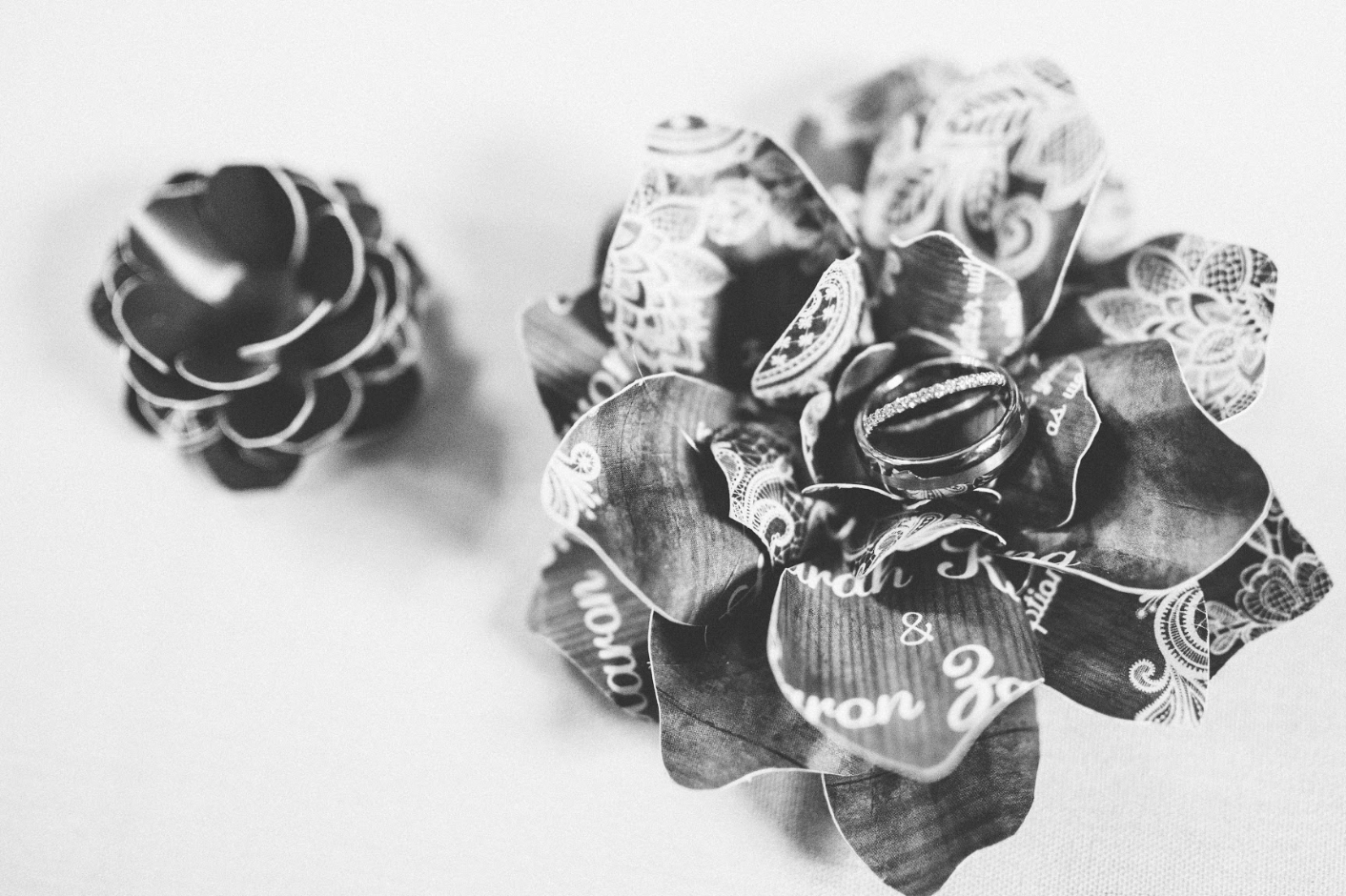
- Special DIY projects. I picked one and it was because I had made a huge mistake: I ordered twice as many invitations as I actually needed. I thought, How could I repurpose all of these card stock invitations? Then I remembered that my mom had recently bought me a book on making paper flowers. So I packed up the invites, drove to her house, and we spent a day together making flowers out of my invitations:
It started off fun, watching chick flicks and cliche wedding movies while we cut out dozens of stencilled petals... but by the end of the day we had only completed 10 flowers between the two of us. It was gruelling and time consuming. But the truth is that we were able to use them without needing 100 of them. They were accent decor, not "mandatory" at every table. I was totally happy with that... as were my blistered hands.

DIY projects are fun and great ideas in hindsight. Some of them might actually be quite doable. But don't feel like you need to put intricate work into something for every single guest - Unless you have the time, patience, and the passion for such a project.

It's okay if you want these things. It's your wedding and you can create the day however you like. But there are times when you need to let things go. They are seriously not worth it.

A friend of mine who is an incredible baker made cookies and brownies for the end of the night at her own wedding. Our venue allowed the same and I had planned on doing some baking for ours as well (otherwise what's the point of owning a Kitchenaid mixer?). But the week before the wedding my schedule got slammed - and not just with wedding stuff... but work, and family, and other commitments. I was exhausted and baking wasn't going to happen. At that point I really didn't care. I didn't even tell the venue until I arrived on the day-of. It wasn't a big deal, but I'm glad I made the decision to let it go.

Rule #2: Avoid overreacting. 

Things go wrong. People have very loud opinions and expectations.
Our planned outdoor ceremony ended up being moved indoors due to a freak ice storm in the middle of April. One of the worst storms in Toronto in years, with rain, freezing rain, snow, slush and ice all within 24 hours. We had an entire table not show up, and even our officiant was a little late to arrive. Shit happens. It wasn't going to stop us from getting married. Nothing would. There was no point in getting angry. We were still getting married, and everything in my eyes was still as perfect as it could be.

But even if something had gone wrong that was someone's obvious fault; there's nothing good that comes out of going full dragon. The important point is to keep a level head. Exhale a deep breath, and then find a solution. One of the best parts of being the bride? You have a team of people who are there for you to troubleshoot.

Our venue (which was also an Inn) made multiple errors with room bookings and didn't have the room I requested available for getting ready in. So as I had my manicure done, my sister went up to the front desk and fixed it all. I didn't stress for a second. The issue would be fixed, or we would somehow find a solution (or another room). There's always a way to make things work. The goal is to not fight the resolution.

And remember - you're getting married! This is a happy day of celebration and everyone is there in support of you and your partner! Create and nurture the positive energy that you want surrounding you on your day.

Rule #3: Let the experts do their job - and trust them!

So you shelled out a few thousand dollars on photography... perhaps hundreds if not thousands on flowers (You've seen these weddings on Pinterest!). There's a reason you're paying so much: You are paying a professional for their time and their skill. Sure, there's the cost of materials, but you sought out your specific vendors because you thought they were the best in your price range, and you seem to really connect with them.

I gave our florist an idea of what I wanted, with flower types and colours, but I honestly had no idea what was in season. She guided me to combinations that ended up being incredible. She put together the most beautiful bouquets, and they were all so simple and romantic. Even when it came to the ribbon around the stems, she made a recommendation and not only did I love it, but I trusted her that it would look amazing (and she didn't disappoint).

Trust your experts. Try to avoid harassing them with phone calls and emails with changes and demands. I'm not saying that you shouldn't stick up for what you want or what you're asking for, but keep an open mind and understand that these people work weddings for a living.

Even if it's not exactly as you had pictured it in your head, try to see the beauty in it. See the love and the handiwork that went into each piece from your vendors/experts.

Rule #4: Call upon your think tank, but avoid getting too many opinions

There were multiple times where I had to make silly little decisions (like, which font looks better for the seating chart?) and I got a little overwhelmed with indecision (mostly because I didn't care about seating chart fonts... I just wanted it to be legible for our guests). Instead of just picking something, I would call upon one of my bridesmaids, or my sister, or mom, or, if the decision was more crucial than fonts, I would bring in my fiancé. I would have 3-4 options ready, then I would ask 1-2 people for their opinion - never more than that. Any more opinions and you will second guess yourself, and now you're trying to please the crowd. Once a decision was made, we stuck to it and moved on.

There's no need to dwell on the tiniest details; but you're also allowed some help in making those decisions. Back to Rule #1: Less is more. You don't need your whole posse there for you when you try on wedding dresses or meet with your florist. Pick one person and enjoy the experience. If you find there's someone who's opinion on the matter would mean a lot to you, then go home and come back another day with that person.

For our wedding cupcakes I went by myself to put down the deposit and then brought home a few different varieties/flavours of cupcakes home for my fiancé so that he could help choose the flavour that we would serve. The point is that you don't have to do everything alone. It's okay to ask for help.

***

I understand that my situation will not apply to everyone, but I hope that these little tidbits of advice will help others beyond the typical "warnings" that women hear. A warning isn't always helpful but guidance on how to better manage the wedding planning and execution is. And that is my hope for today's blog post. I'll be posting again soon for Part 2: Self-Care for the Mindful Bride

Saturday, March 31, 2018

6 products that most women would do best to avoid

I recently saw the swag bag that's being given out for those who participate in one of the Women's runs, here in Toronto. Now, don't get me wrong, I love a good swag bag. It's one of the perks of running a race.

What grabbed my attention was the number of items in this "Women's swag bag" that can actually sabotage a woman's hormonal health. Maybe not dramatically or from a single use/consumption, but long-term, or for those who already have hormonal issues.

Here are a few examples of products that most women should avoid, while trying not to call out specific brand names.

1) Commercial brand granola bars
           These are often laden with sugar; Both in the number of types of sugar and in the grams per serving. Upon reading the ingredients label you'll notice that a single product can contain all of the following: Brown sugar, Honey, Glucose, Sugar, and Glycerin. That's 5 different "types" of sweeteners in a single granola bar (as listed by a specific brand), with 5g of sugar and only 1g of protein and only 2g of fiber per serving. Shouldn't a granola bar be high in fiber?
           Additionally, we find chemical preservatives like BHT, artificial flavouring, and "modified milk ingredients." On a scale of healthy snacks, this one shouldn't even be an option.

2) "Nutritional" or Meal replacement shakes
           It makes me sick that we actually feed these to people. Sure, they're fantastic for helping certain people gain weight, but that's because each serving contains roughly 40g of carbohydrates with 1/2 of that coming from multiple sources of sugar and even more added sweeteners.
         Additionally, there are multiple ingredients that aren't well tolerated, especially as we age. 
→ Carrageenan is what researchers in animal labs use to induce inflammation. It can also be a cause of headaches and migraines for some women. 
"Vegetable oil" often contributes to high omega-6:omega-3 ratios in the diet - meaning more inflammation. This can manifest as IBS, joint pain, painful periods, depression, and brain fog.
Milk protein concentrate. Not a terrible ingredient for the average person, but as we age we lose our concentration of available lactase enzymes. Thus, as we age, we become more lactose-intolerant to some degree. For women specifically, I often recommend avoidance of all or most cow dairy as it is a common aggregator of digestion issues, hormonal imbalances, and increased inflammation.

3) Vaginal lubricants and wipes
      Vaginal dryness can often be a sign of a hormonal imbalance of estrogen. Avoid products that contain:
Glycerin: a sugar that introduced vaginally can lead to a greater incidence of yeast infections. 
Parabens like ethylparaben, methylparaben, etc. These are known hormone disruptors. 
→ Polypropylene glycol can be irritating, especially to sensitive tissue.

4) Commercially branded Hair and Body products that contain:
Sodium lauryl/laureth sulfates: these are foaming agents that can dry out skin and can cause reactions for those with sensitive skin. 
Cetyl or Stearyl alcohols: avoid products that have alcohol near the top of the ingredient list if you have dry skin or eczema. Alcohol in creams or body products can be even more drying and cause eczema lesions to become painful.
Fragrance: fragrances that are not disclosed as essential oils are often synthetic and are known hormone disruptors. They can also induce headaches and other neurological symptoms, not just in the user, but in those around them. 
→ Parabens for the same reasons as above.

5) Anti-perspirants
       Using aluminum products to clog your sweat ducts stops you from being able to eliminate toxins from your skin in those areas. We're supposed to sweat. It's part of our homeostatic regulatory system, and part of the body's detoxifying system. If you're using products like the ones above, your body has to get rid of those chemicals like phthalates, and it does so through sweat, urine and feces. If you're excessively sweating, it's time to have the root cause evaluated. 
Read more on one of my previous blog posts and make your own deodorant! 

6) Tampons
    As a previous user, I can understand the frustration with me adding tampons to this list. But the problems that tampons can cause go beyond toxic shock syndrome. Tampons soak up everything they're in contact with; Not only menstrual fluid, but your natural vaginal secretions and discharges. This fluid is critical for maintaining proper vaginal pH (prevents you from getting bacterial vaginosis - itching, redness, and subsequent infections), keeping tissues moist and happy, and keeping your vaginal flora healthy. If you tend to get yeast infections frequently, stop using tampons all together. Some women who have other sensitivities or sensitive skin would also do best to avoid tampon use due to fragrances, bleaches and dioxins. 

The point here is to educate women and have people in general be more informed on the products they're purchasing and using in and on their bodies. 

Rick Smith and Bruce Lourie's book Slow Death by Rubber Duck discusses the environmental toxins that we expose ourselves to everyday, but also on the mechanisms our body has for eliminating them. It is an eye-opening read that I highly recommend. 

I also recommend EWG's webpage Myths of Cosmetic Safety for more information: https://www.ewg.org/skindeep/myths-on-cosmetics-safety/#.Wr_BWmYZNsM

Thursday, March 22, 2018

6 Ways to Prevent Knee Soreness and Injuries for Runners

So you wanna run, but your knees get too sore? I hear this frequently, and can understand the feeling. Most of the time, doing some training to start running can help but there are other considerations as well.

When I first started running I just wanted to get out there. I didn't have any accumulated running gear,  and I was hitting the concrete streets of Toronto. At first it was uncomfortable - like my body didn't quite understand how to run, or how to run properly. I thought I was in good shape, but my heart was racing, and I was sore!

Fast forward to today and my knees have become a non-concern. It takes conditioning, the right gear and the right type of run, but you too can run with less knee pain.

Here are my top tips for reducing the knee pain of running:

1) Wear really good running shoes and rotate them often.
        Purchase one pair of really great (and often more expensive) running shoes, but make sure to replace them within about 6 months - earlier if you're covering more distance in them. For runners hitting about 20-40km per week, your shoes might only last you 3-4 months. Or, you can purchase several pairs and rotate them frequently. Each pair of shoes will last longer in that way, though you may have to spend more in the short-term.

2) Strengthen your hips!
       You can relieve the strain on your knees by increasing the strength of your hips and glutes. This even extends into the pelvic cavity and low back as strengthening these muscle groups help to keep the body and joints more stable. Lunges, squats, hip adduction and hip abduction will all support this.
       Yoga can also act as a strengthening exercise for those muscles. Look for yoga videos or classes specifically tailored to runners. Christine Felstead has a great book called "Yoga for Runners" as well, and she often teaches at the annual Toronto Yoga Conference & Show.
       At the same time, beware of deep tissue work that can over relax major muscle groups. Using a foam roller on the legs - especially the IT band - is fantastic, and can help to decrease knee soreness. However, a really deep tissue massage of the low back, hips and glutes might actually set you back by a few days. It's not uncommon to feel a little too loose and wonky after a really tough massage, so be prepared to restrengthen those muscle groups.
   
3) Avoid running on concrete.
        Cement has very little give for a runner compared to a trail. If you can run on softer surfaces, opt for that! With a slightly lesser impact, your joints feel less of a shock. Myself personally, I find that I'm more sore the day after I've run on concrete versus a dirt trail or boardwalk.

4) Run with a mid-foot strike, or on the balls of the feet. 
       Running with a heel-strike may look good in an advertisement, but mechanically is murderous on your legs. When you strike with your heel, the impact of that strike shoots up the leg with a more compressive force on the knee and hip joints. By using the mid-foot or balls of the feet, the back half of your foot acts as a sort-of shock absorber. This allows you to bounce more gently, taking the pressure off the knee joint and putting it more on your muscles to catch you and propel you forward.
       The only downside to this is that some newer runners may notice shin splints when starting this technique. Doing a proper warm-up and post-run stretch can help alleviate that stress. As can magnesium, foam rolling, and using hot and cold water therapy as appropriate.

5) Consider additional joint support via supplementation. 
       Depending on your age and physical and medical history, this might include cartilage helpers like glucosamine and chondroitin; anti-inflammatory substances such as Omega-3 fish oil and curcumin; or other vitamin, mineral, and amino acid support such as vitamin C, hydrolyzed collagen, and bone broths.

6) Visit a physiotherapist
       If you're unsure about your running technique and you're getting pain or soreness, it might be time to go see a physiotherapist. They can assess your gait and stance, perform muscle testing, and then set you up with stretching and/or active motion exercises to reduce your pain and support proper body mechanics. (If you have insurance benefits for physio, this one is a no-brainer!)

Wednesday, March 14, 2018

How to properly take care of your feet

Our feet take us everywhere. Some of us stay on our feet all day, giving them the burden of our entire body against gravity. A lot of us love shoes, and often shove our feet into any pair that pulls at our fashion-heartstrings; But how much extra care do we take of our feet? I'm talking beyond the aesthetics of and the stress-relieving massage of a good pedicure.

Taking care of our feet can relate to taking care of the entire body. It comes down to the "use it or lose it" theory: Any muscle or combination of functions that aren't used after a period of time will degrade or atrophy. To make the body stronger, we have to use it; use our muscles, use our brain power, etc.

Think about how often you use your feet while they are bare, on a flat supportive ground, compared to when they are sheltered or braced by thick socks, cushioned running shoes, or constricting high-heeled shoes. How often do you get to feel your toes splayed out rather then squished together?

There are 19 different muscles in the human foot, and over 100 ligaments! And especially important ones seeing as how they support us while standing, propel us while walking, and catch us while running.

More of us could do with a little foot conditioning. Properly taking care of feet includes strengthening them, preventing the muscles from atrophying, and protecting other joints such as the knees, hips and all the muscles in-between that have to compensate when we have weak feet and ankles.

How can you better take care of your feet and lower body?

1) Spend more time barefoot. 
Being barefoot connects you to the ground. You can do it within your home, but it's even more beneficial if done on the earth or grass. There are actually mental health benefits to walking barefoot through dewy grass! Grounding also helps bring you to the present. It literally connects you to the ground and can be a part of a mindfulness exercise.

2) Yoga
 Yoga is an incredible practice into strengthening your feet. Allow the toes to spread wide. Plant your feet and/or practice your balance postures. A yoga practice can be a fantastic way to strengthen your feet and whole body.


3) Other exercises and recovery. 
For injuries such as plantar fasciitis, work to stretch and strengthen the feet by drawing out the letters of the alphabet with your feet/toes (one foot at a time), then roll a frozen water bottle or lacrosse ball under your foot between the heel and the balls of the feet. Drawing the alphabet requires you to use multiple muscles of the foot, while the ice or ball will help to loosen tissue stiffness, adhesions and will reduce inflammation (with ice).

4) Ditch the high heels
High heeled shoes are a menace for your feet, knees and hips. They can completely change the body's posture, and put more strain on the lower body. Additionally, most high-heels require the toes to be compressed together, completely eliminating their function in balancing the body, while significantly affecting blood flow to the feet and toes.

5) Foot massages and Epsom salt foot baths
For extra pampering, give yourself a quick foot treatment. Forget the nail polish and just give yourself (or get someone else to help you) a foot massage. Knead into your arches, and gently traction the toes. You can even precede this with a foot soak in Epsom salts to help relax the muscles of the foot (soak for a minimum 20 minutes).

Give your feet the attention and love they deserve. And even more, keep them strong so that they can prevent injuries in other parts of the body.